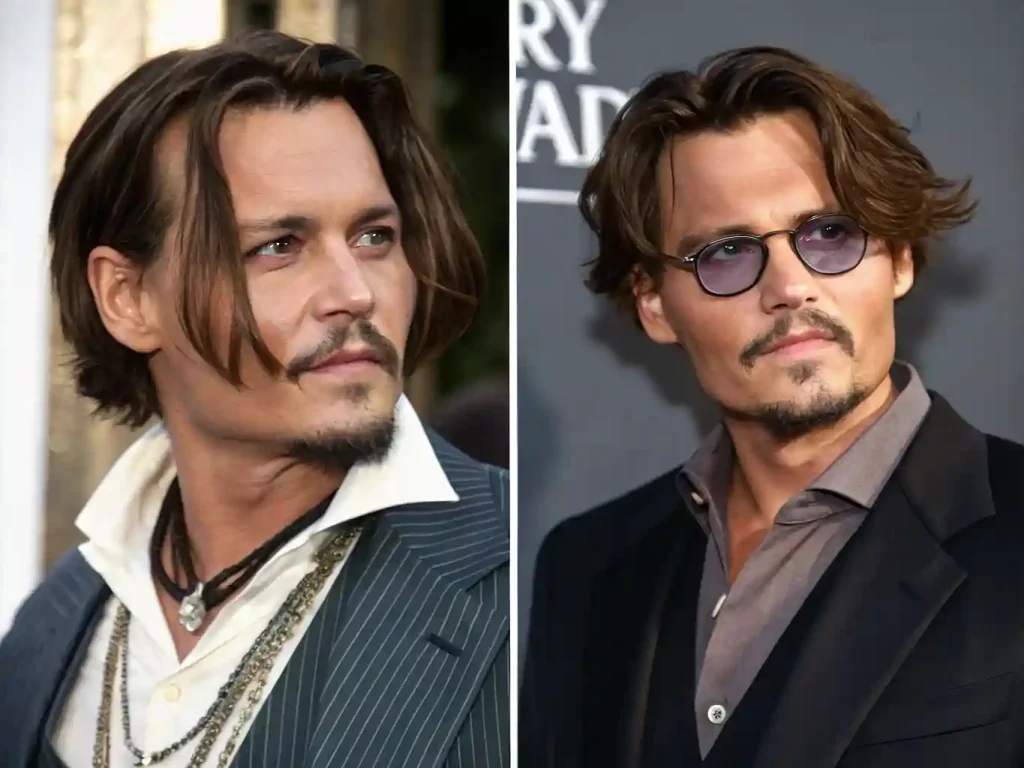
Johnny Depp’s transformation has become one of the most discussed stories around modern Hollywood because it is not only about hair, clothes or age. It is about how a familiar screen figure has changed his public rhythm, career choices and image after years of intense attention. For a long time, Depp was seen through the lens of eccentric characters, red carpets, rock-star style and the long shadow of Captain Jack Sparrow. Now the conversation is different. His return is quieter, more selective and more layered.
The actor who once seemed inseparable from blockbuster franchises is reappearing through a mix of European cinema, directing work, studio-backed thrillers and carefully watched public appearances. His new image feels older, sharper and more controlled, but not empty of the theatrical quality that made him famous. The change is visible on the surface, yet the more interesting shift is professional. Depp is not trying to repeat the exact version of himself that dominated the 2000s. He is building a new phase around mystery, age, distance and creative control.
The new public image
Johnny Depp’s appearance has always been part of his screen identity. Long before social media turned every public photo into a headline, Depp used style as a kind of personal language. The rings, scarves, tinted glasses, hats, layered jackets and slightly bohemian look became instantly recognizable. It was not polished in the classic Hollywood sense. It looked lived-in, musical and theatrical, as if he had walked out of a rehearsal room, an old bar or a film set rather than a stylist’s showroom.
The recent change is different because it does not simply extend that old image. Depp now appears more restrained in public, and when a new look does arrive, it often feels tied to a role rather than a spontaneous celebrity moment. The first images connected to Day Drinker showed a dramatically altered Depp: silver hair, a heavy grey beard, blue contacts and a smoother, colder elegance than fans were used to seeing from him. The reaction was immediate because the look did not feel like a small adjustment. It suggested a character who belongs to the world of luxury, secrets and danger rather than the chaotic romance of his earlier screen creations.
That visual transformation matters because Depp’s face has carried many cultural meanings over the years. In the 1990s, it stood for anti-mainstream cool. In the 2000s, it became linked with fantasy, risk and huge box-office success. During the years of legal battles and public conflict, it was discussed less as an actor’s face and more as a symbol inside a media storm. Now the new image gives him room to be looked at again as a performer. The grey hair and beard do not try to hide time. They use it.
This is one reason the new Depp feels more interesting than a simple comeback narrative. Many actors return to the screen by trying to look untouched by the years. Depp’s current phase seems to move in the opposite direction. His image carries age, fatigue, glamour and strangeness at once. That combination suits him because his best roles have rarely depended on ordinary leading-man perfection. He has always been strongest when beauty, instability and sadness sit in the same frame.
His public behavior has also changed. The mood around him is less loud than during his highest commercial period. There are fewer signs of the nonstop promotional machine that surrounded Pirates of the Caribbean, Alice in Wonderland and other major studio projects. Instead, the return has been scattered across festivals, European productions, art-related appearances and carefully selected film news. This slower rhythm helps reshape the way audiences read him. He is no longer presented only as a franchise star. He is also a survivor of a difficult public chapter, a director returning to old creative ambitions and a performer entering older, darker character territory.
From scandal fatigue to selective visibility
The most important change in Johnny Depp’s career is not only what he is doing, but how he is being seen again. For several years, his name was tied more to headlines than to performances. The public legal conflict with Amber Heard, his exit from Fantastic Beasts, and the wider debate around his reputation changed the way studios, audiences and media outlets talked about him. Whatever side people took, one fact became clear: Depp’s career could not simply continue as if nothing had happened.
That pause altered his relationship with Hollywood. Before it, Depp was a global star with a long record of commercial power. After it, every new role carried an extra question: was this a true professional return, a cautious test, or only a temporary appearance? That is why his recent projects have attracted so much attention. They are not judged only as films. They are read as signals.
His return began away from the safest studio path. Jeanne du Barry, in which he played King Louis XV, put him back on screen in a European historical drama rather than a giant American franchise. The choice was telling. A French-language period film is not the obvious route for a Hollywood star trying to regain commercial status. Yet it allowed Depp to re-enter cinema in a setting where performance, presence and controversy could coexist without the pressure of carrying a global blockbuster.
Then came Modi, Three Days on the Wing of Madness, a project that moved him behind the camera. Directing a film about Amedeo Modigliani was a revealing step because it connected Depp to an artist known for intensity, rebellion and emotional excess. It also showed that he was not limiting his return to acting offers. He wanted to work from a position of authorship, even if the results divided critics. That matters because Depp’s career has always been shaped by taste as much as strategy. He has repeatedly chosen outsiders, misfits, eccentrics and wounded figures over clean heroic archetypes.
The shift from scandal fatigue to selective visibility has helped Depp regain some control over his story. He is not appearing everywhere at once. He is allowing each project to carry a piece of the larger narrative. A royal role in Jeanne du Barry suggested historical distance and dignity. Modi suggested artistic identification and creative independence. Day Drinker suggests a return to a more commercial, genre-driven Hollywood space. Together, these choices create a gradual reintroduction rather than a sudden attempt to erase the past.
This slower approach also reduces the risk of overexposure. Depp was once everywhere: on posters, magazine covers, talk shows, music stages and franchise campaigns. That kind of visibility helped make him one of the most famous actors in the world, but it also made him vulnerable when public opinion turned. His current phase is more careful. It gives audiences time to separate the man from the noise and look again at the work.
Roles that mark the comeback
The roles connected with Depp’s return show a clear movement from European art cinema back toward American studio filmmaking. This does not mean he has returned to the same position he held at the peak of Pirates of the Caribbean. The industry has changed, audience habits have changed, and Depp himself has changed. What is visible now is a career rebuilding through contrast: aristocrat, artist, mysterious stranger, possible Dickensian figure.
Jeanne du Barry gave Depp a role wrapped in ceremony. Playing King Louis XV required a kind of stillness that contrasts sharply with the physical chaos of Jack Sparrow or the gothic exaggeration of earlier Tim Burton collaborations. The role did not ask him to dominate the film with comic invention. It placed him inside a historical world where gesture, status and silence mattered. For an actor whose reputation had become loud in the press, that restraint had symbolic weight.
Modi was important for different reasons. Depp did not return to directing with a safe mainstream story. He chose a film about art, failure, pressure and creative defiance. Even the title, with its emphasis on three intense days, points toward compression rather than spectacle. The project also linked him with Al Pacino, whose involvement gave the film a sense of old Hollywood seriousness. Whether one sees Modi as a triumph, a flawed experiment or a personal statement, it clearly belongs to Depp’s long fascination with artists who resist ordinary life.
Day Drinker is the project that most clearly signals his commercial Hollywood return. Directed by Marc Webb and backed by Lionsgate, the film places Depp alongside Penélope Cruz and Madelyn Cline in a thriller about a private yacht bartender, a mysterious onboard guest and a criminal figure. This is not a small festival-only project. It has recognizable names, genre appeal and the kind of premise that can sell internationally. It also reunites Depp and Cruz, whose previous screen history includes Blow, Pirates of the Caribbean: On Stranger Tides and Murder on the Orient Express.
The following overview shows how the recent projects fit into the broader change in Depp’s career direction.
| Project | Depp’s role | Why it matters |
|---|---|---|
| Jeanne du Barry | King Louis XV | Marked his visible return to screen acting through European period cinema. |
| Modi, Three Days on the Wing of Madness | Director | Reintroduced him as a filmmaker and connected his comeback to art, risk and personal taste. |
| Day Drinker | Mysterious onboard guest, Kelly | Signals a studio-backed Hollywood return with a commercial thriller format. |
| Ebenezer: A Christmas Carol | Reported potential role as Ebenezer Scrooge | Suggests interest in older, darker literary characters if the project fully moves forward. |
| The Carnival at the End of Days | Reported development connection | Keeps him linked to surreal, auteur-driven cinema rather than only safe studio work. |
This pattern is revealing because the roles are not designed to make Depp look young again. They lean into mystery, history, eccentricity and moral shadow. Even the rumored or developing projects fit that direction. Ebenezer Scrooge, if it becomes part of his filmography, would be a character built around age, regret, isolation and transformation. That would suit the current Depp more naturally than a forced attempt to revive the romantic rebel of his youth.
The strongest sign of a real comeback is not that every project is guaranteed to succeed. It is that he is again being discussed through work. Casting, directing, genre, collaborators and performance choices have returned to the center of the conversation. For an actor whose public image had become consumed by personal controversy, that is a meaningful shift.
Why day drinker matters
Day Drinker stands out because it looks like the bridge between Depp’s European comeback and a wider Hollywood return. The film has a studio framework, a recognizable director, an international cast and a thriller premise that can reach audiences beyond festival circles. For Depp, this is not just another acting job. It is a test of whether mainstream commercial cinema is ready to position him as a leading presence again.
The first look from the film did much of the promotional work on its own. Depp’s silver-haired, bearded appearance created instant discussion because it offered a version of him that was familiar and unfamiliar at the same time. He still looked theatrical, but not in the old pirate-like way. The image suggested elegance, danger and emotional distance. It invited viewers to wonder who this man is rather than simply recognize the star behind him.
That is useful for a thriller. Depp’s strongest performances often come when the audience cannot fully decide whether to trust him. He has played innocent dreamers, frauds, criminals, monsters, artists and men who seem to live halfway outside ordinary reality. A mysterious guest on a yacht gives him a role that can draw from all of those qualities without depending on imitation of his earlier successes.
The partnership with Penélope Cruz also matters. Their screen history gives the project a built-in sense of continuity. They have appeared together in crime drama, fantasy adventure and ensemble mystery. In Day Drinker, that history can mature into something sharper. Cruz brings glamour, intelligence and danger to the project, while Depp’s current image suggests secrecy and damage. The pairing feels less nostalgic than strategic because both actors can carry old-school star power without needing to explain it.
Several elements make Day Drinker especially important for Depp’s next phase:
- It places him back inside a recognizable Hollywood production rather than a limited art-house lane.
- It gives him a genre role where mystery and age can work in his favor.
- It pairs him with Penélope Cruz, a collaborator who connects his past success to his present return.
- It introduces him to younger audiences through Madelyn Cline and other newer cast members.
- It allows the industry to measure audience interest without relying on an old franchise.
The final point is crucial. A true return cannot depend only on nostalgia for Jack Sparrow. Depp’s legacy will always include that character, but his future needs roles that can stand without it. Day Drinker gives him that opportunity. It does not ask audiences to forget who he was. It asks whether they are curious about who he can be now.
A different kind of hollywood return
Hollywood comebacks often follow a familiar pattern: a star disappears, returns in one big film, gives interviews about redemption, then tries to reclaim the old position. Depp’s situation is more complicated. His return is not happening in a single dramatic moment. It is unfolding through fragments: a European royal role, a directing project, an art-world story, a thriller with Lionsgate, reports of future literary and fantasy projects, and ongoing speculation about old franchises.
This makes his comeback less clean but more believable. Depp is not stepping back into the industry as if time stopped. He is returning to a Hollywood that is more cautious, more data-driven and more fragmented than the one that made him a global box-office force. Studios now rely heavily on franchises, streaming value, international sales and risk management. A star’s name alone does not guarantee the same result it once did. That means Depp’s return has to prove itself project by project.
There is also a difference between being forgiven, being marketable and being artistically useful. These are not the same thing. Some viewers remain loyal to Depp and see his return as overdue. Others remain uncomfortable with the public history surrounding him. Studios will be watching not only box-office numbers, but also the tone of audience reaction, press coverage and international demand. His comeback is therefore both creative and commercial.
Depp’s advantage is that he has never been a conventional star. His appeal was always based on oddness as much as charm. He did not become huge by playing ordinary heroes. He became huge by making strange choices feel emotionally accessible. That quality may help him in older roles because he does not need to compete with younger leading men on their terms. He can move toward characters who are haunted, elegant, morally unclear or artistically extreme.
His challenge is that the industry may still hesitate to build very expensive films around him. A mid-budget thriller, a literary adaptation, a European co-production or an auteur project may be a more realistic path than an immediate return to mega-franchise dominance. That is not necessarily a weakness. It may give him better material. Some of Depp’s most respected work came from roles that were not designed by committee: Edward Scissorhands, Ed Wood, Donnie Brasco, Fear and Loathing in Las Vegas, Finding Neverland, Sweeney Todd.
The question is not whether he can become the same Hollywood figure again. He cannot, because no actor can return unchanged to an industry that has also changed. The more useful question is whether Depp can turn age, controversy and distance into a new screen language. The early signs suggest that this is exactly what he is trying to do.
What the change means for his legacy
Johnny Depp’s legacy has always been unusually unstable. Few actors have moved so dramatically between cult credibility and blockbuster dominance. He began as a teen idol, resisted that label, became an art-house favorite, turned into one of the world’s biggest movie stars, then became the center of one of the most public celebrity controversies of the modern era. Any honest assessment of his change has to hold all of that at once.
The new phase does not erase the past. It adds another layer to it. Depp’s strongest legacy may eventually be that of an actor who repeatedly remade his own image, sometimes successfully and sometimes chaotically. He was never simply handsome, never simply eccentric, never simply commercial and never simply rebellious. His career has always depended on contradiction. That is why the current version of Depp, older and more guarded, still feels connected to the actor audiences first found compelling.
The transformation also changes how some of his earlier roles look. Jack Sparrow, once seen mainly as a comic adventure icon, now feels like part of a larger pattern of outsiders and damaged performers. Edward Scissorhands looks even more like a blueprint for Depp’s interest in innocence and isolation. Ed Wood, Sweeney Todd and the Mad Hatter all belong to a world where performance is a mask and a wound at the same time. The new roles continue that pattern, but with less youthful flamboyance and more visible melancholy.
For younger viewers, Depp may now be less of a guaranteed blockbuster star and more of a controversial cultural figure returning through selected work. For older fans, the change may feel like a reminder of why he mattered before the franchise years consumed the conversation. For Hollywood, he remains a complicated asset: famous, talented, risky, internationally recognizable and difficult to place in a simple category.
That complexity is exactly why his return attracts attention. A bland comeback would not suit him. Depp’s screen identity has always needed tension. The new look, the grey beard, the European projects, the directing work and the studio thriller all point toward a man trying to turn a damaged public chapter into a different artistic phase. Whether that phase becomes fully successful will depend on the quality of the films, not only on curiosity around his name.
Conclusion
Johnny Depp has changed because time, conflict and career disruption have forced him to change. His new image is older and more severe, but it also feels more honest than a polished attempt to recreate the past. His recent and upcoming roles suggest an actor drawn to mystery, regret, authority, danger and artistic obsession. That direction makes sense. Depp has always been most convincing when playing people who seem slightly removed from normal life.
His return to Hollywood is real, but it is not simple. It is not a clean reset and not a guaranteed restoration of former power. It is a careful re-entry built through European cinema, directing, genre work and selective visibility. Day Drinker may become the clearest test of this new phase because it brings him back into a studio-backed production without relying on an old franchise.
The most interesting thing about Johnny Depp now is that he is not trying to look untouched. He is letting the years show, and the roles around him are beginning to use that. If the next films give him characters with depth rather than only headlines, his comeback could become more than a celebrity story. It could become the late-career chapter of an actor who still knows how to turn strangeness into screen presence.